
Last updated September 19, 2026
Full 25-point door and opener safety check with every visit - springs, cables, rollers, tracks, and your LiftMaster or Chamberlain opener included
You get a price before we start. It does not change when the truck arrives.
 Before
 After
After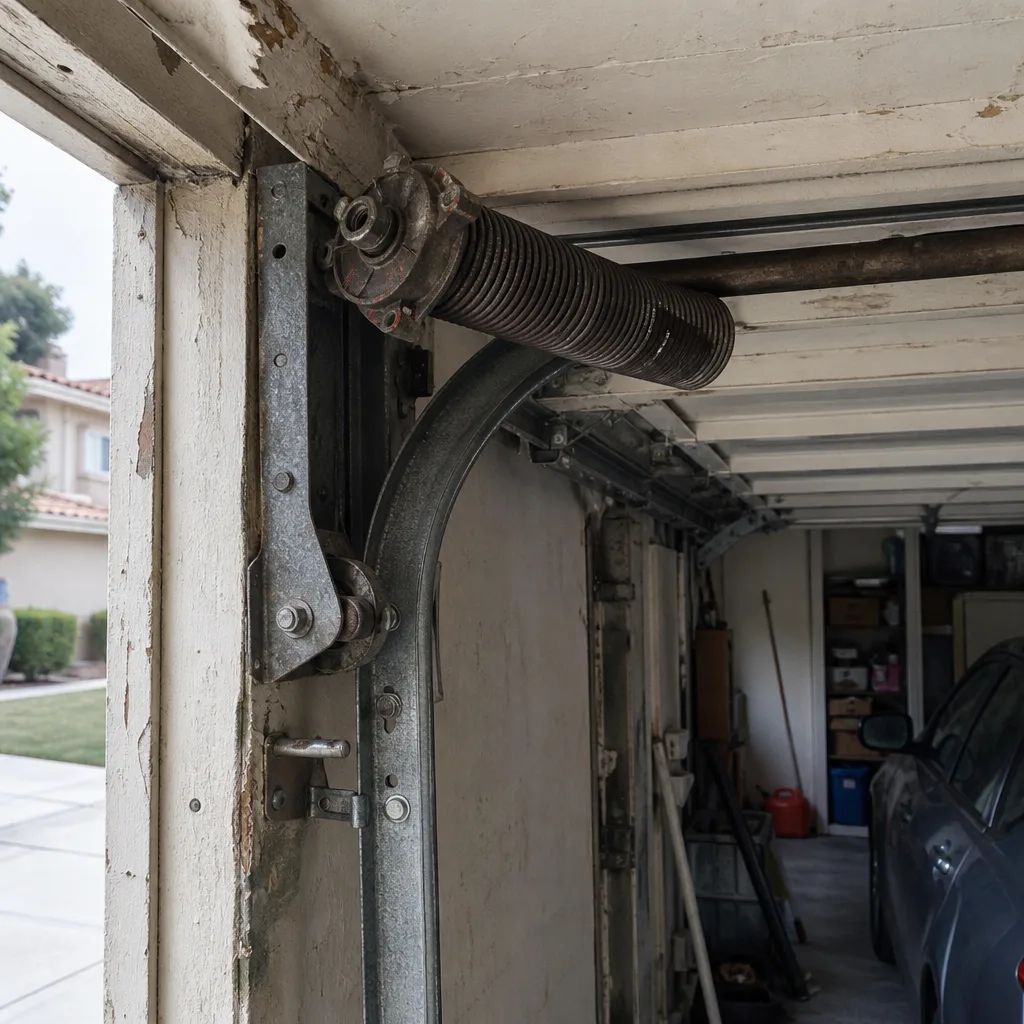 Before
 After
AfterDIY vs Professional Garage Door: The Irvine Homeowner’s Decision Guide
Torsion springs store roughly 100 foot-pounds of torque when wound. That’s enough to break a wrist or fracture a forearm if a winding bar slips, and it’s the reason the DIY-versus-professional conversation about garage doors is unlike any other home repair debate. The question isn’t whether you’re handy. It’s whether the $150 you’d save on labor covers the deductible on the ER visit it occasionally produces. This guide draws a clear line through the garage door system, separating what an Irvine homeowner can safely do on a Saturday morning from what should be left to someone who winds springs for a living, and it complements our Garage Door Repair Maintenance Checklist for Irvine Homeowners. You’ll learn which tasks carry real injury or liability risk, what California code says about garage door work, and where the sensible middle ground sits.
Quick Answer
DIY is appropriate for lubrication, weather seal replacement, remote batteries, and most limit switch adjustments. DIY is not appropriate for torsion spring work, cable tensioning, or structural header repairs. In Irvine, the dividing line runs through the spring system, not the entire door, and crossing it to save a labor charge usually costs more than the labor charge.
Table of Contents
- The Hard Line: What’s Safe to DIY and What Isn’t
- California Liability Context: When DIY Becomes Legally Risky
- Tool and Part Sourcing Reality for Irvine Homeowners
- The Correct Hybrid Approach: What to Do Before the Technician Arrives
- How to Evaluate Whether a Professional Repair Is Priced Fairly
- What DIY Actually Costs in Total Hours
- Common Mistakes to Avoid
- When to Call a Professional
- Frequently Asked Questions
- The Bottom Line
BeforeAfterThe Hard Line: What’s Safe to DIY and What Isn’t
Garage doors are not all-or-nothing machines. They’re assemblies of discrete components, and the risk profile varies enormously from one component to the next. Understanding where the line sits is the single most useful piece of knowledge an Irvine homeowner can have before opening the tool chest.
The safe side of the line includes four tasks that almost any homeowner can handle without specialized training or equipment:
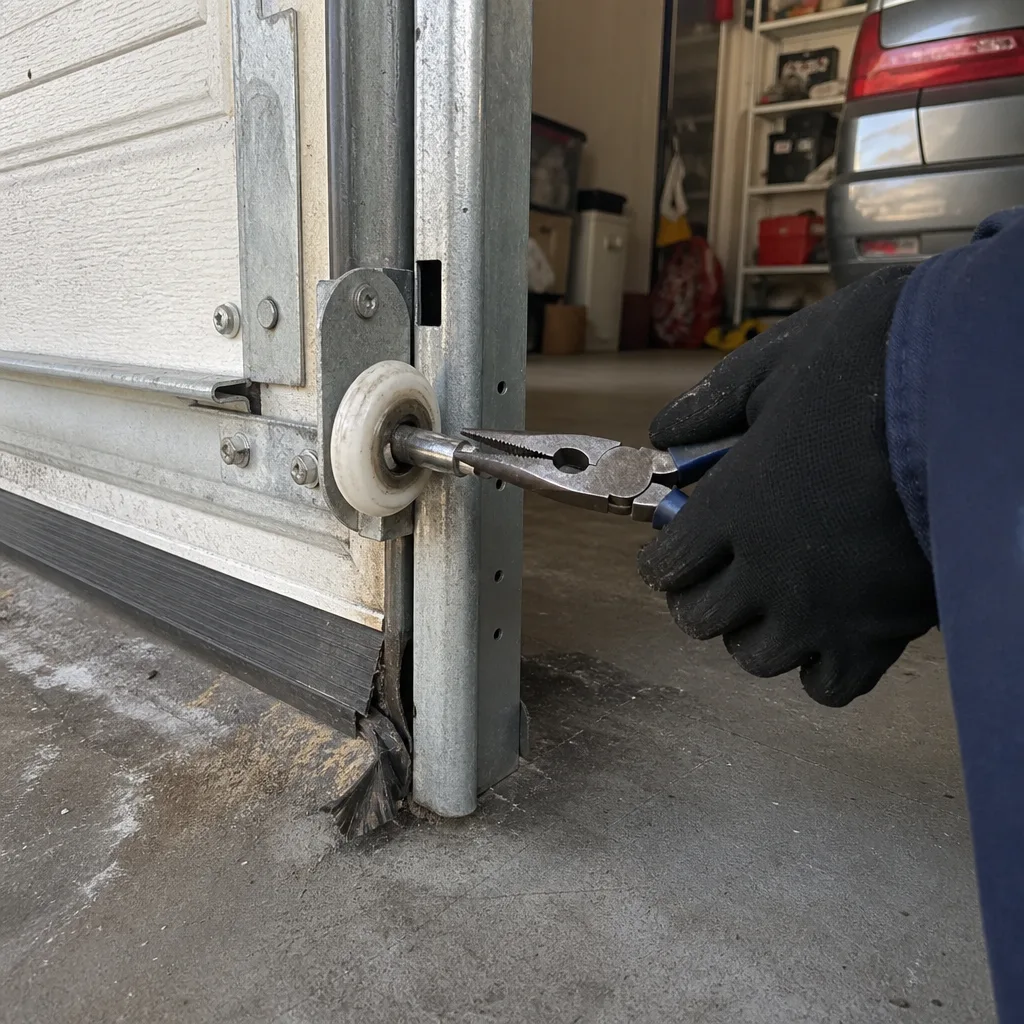
- Lubricating hinges and rollers. A can of white lithium grease on the hinge pins and a silicone spray on the nylon rollers keeps metal from grinding against metal. Twice a year is enough in Irvine’s climate, where the absence of rust doesn’t mean the absence of friction.
- Replacing weather seals. The rubber strip along the bottom of the door and the vinyl trim around the frame wear out every three to five years, especially on west-facing homes in neighborhoods like Woodbury and Portola Springs where afternoon sun bakes the exterior. This is a pull-out, slide-in job with no tension involved.
- Swapping remote batteries. If the opener clicks but the door doesn’t move, and the wall button works fine, the remote’s coin cell is dead. This is a two-minute fix, and most Irvine hardware stores stock the exact sizes.
- Adjusting limit switches on most operators. The limit switch tells the opener where the door stops at the top and bottom of its travel. If your LiftMaster or Chamberlain opener stops six inches short of the floor, a flathead screwdriver adjustment on the motor unit is a legitimate DIY fix. The operator is not under tension.
The unsafe side of the line is shorter but absolute:
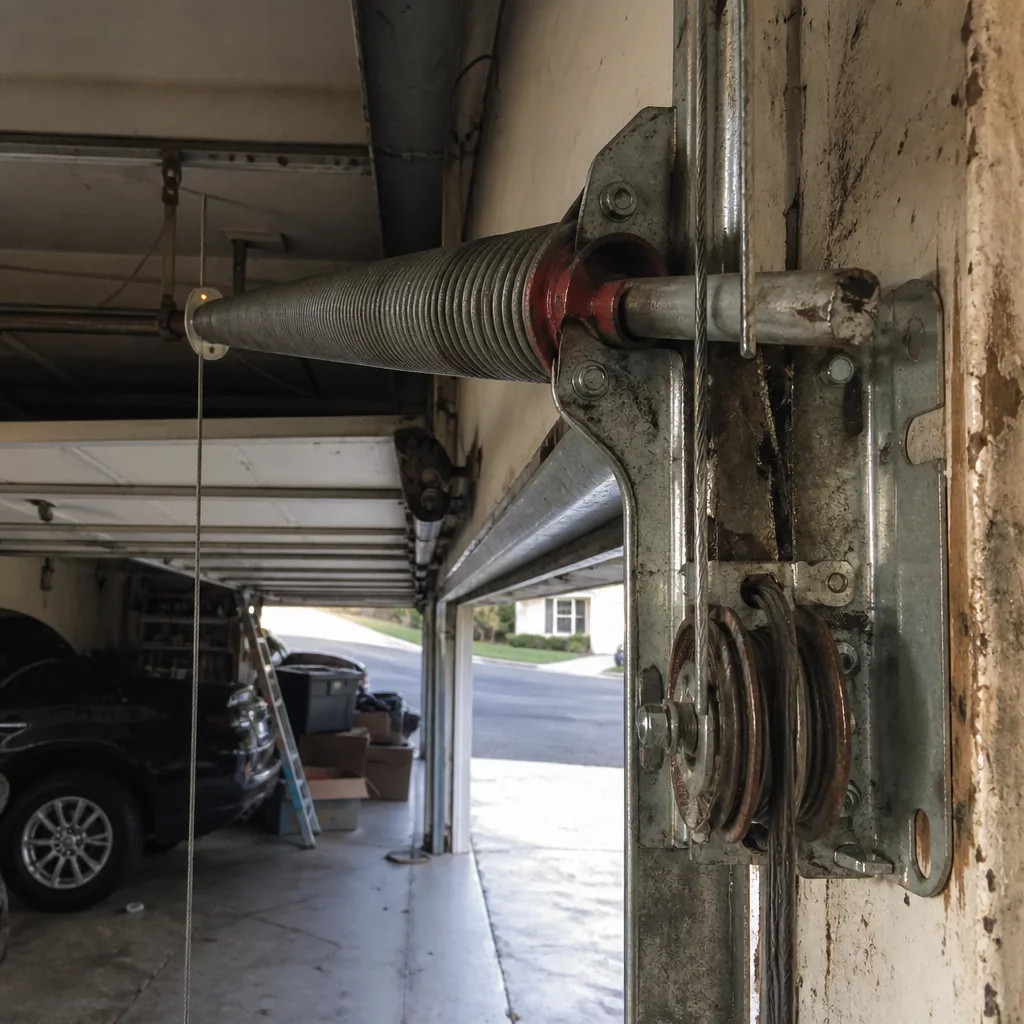
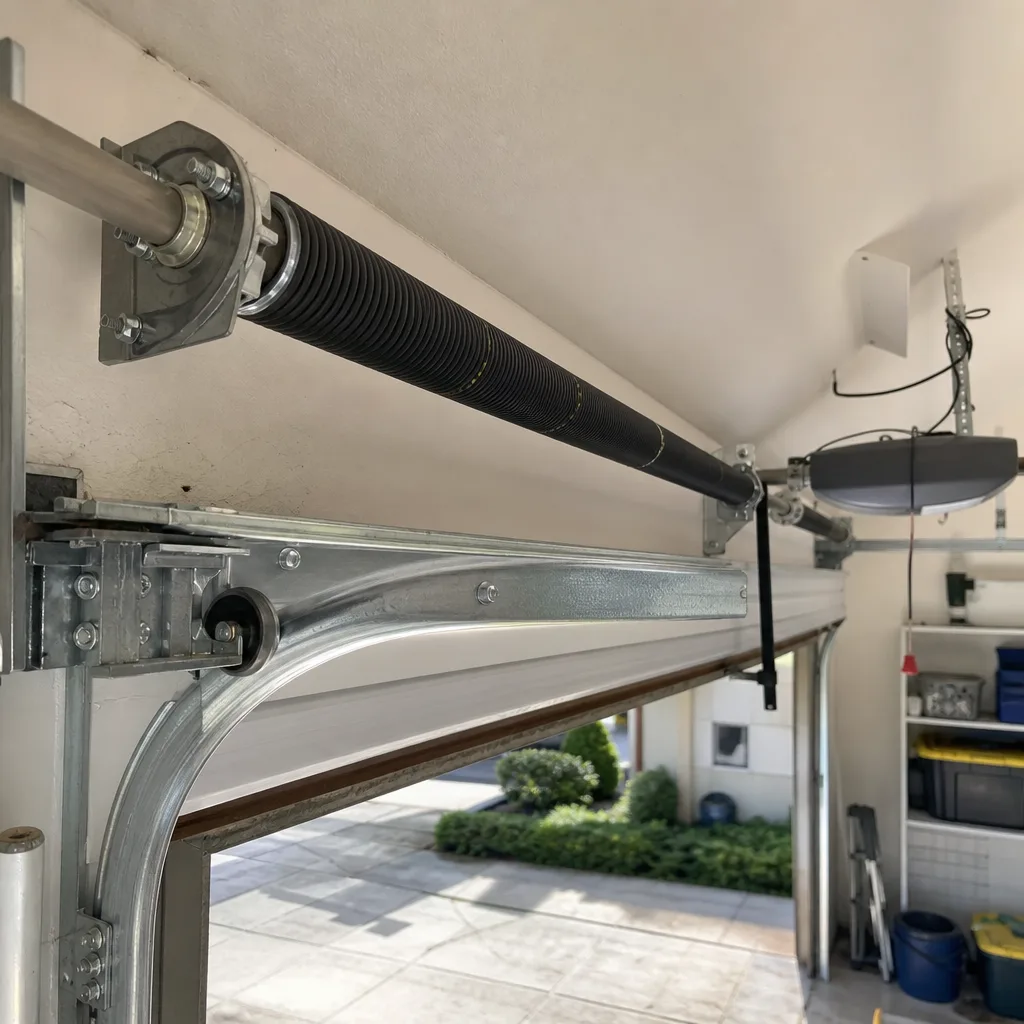
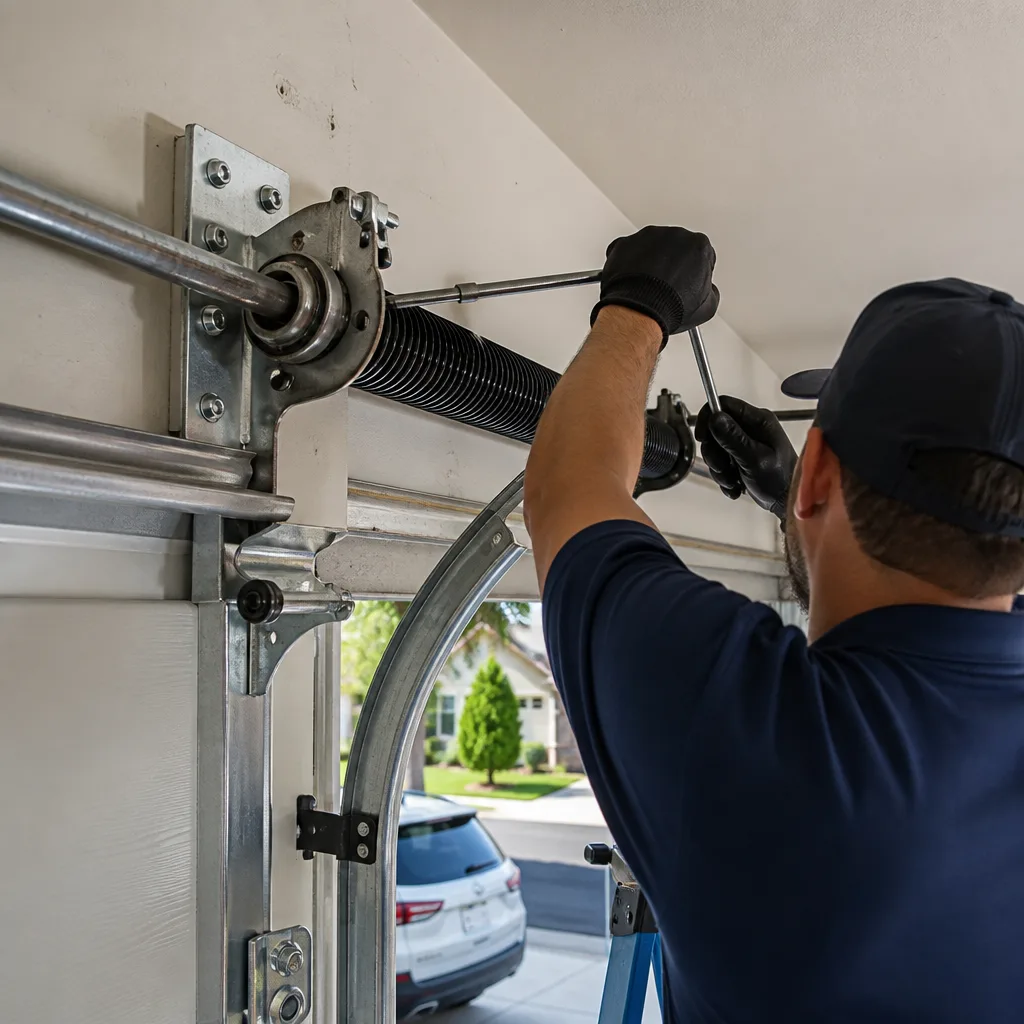
- Torsion spring winding and replacement. The torsion spring is the tightly coiled steel spring mounted on a shaft above the door. It counterbalances the door’s weight. Winding it requires inserting steel bars into a cone and rotating against 100 foot-pounds of stored torque. If a bar slips, the spring unwinds instantly into whatever is in its path. This is the single most common cause of garage-door-related injury in the United States.
- Cable tensioning. The cables attach to the bottom brackets and wrap around drums on each side. They carry the door’s weight when the spring system is active. Replacing a frayed cable without first releasing the spring tension means the cable will snap under load, and the door will drop.
- Structural header work. The header is the beam above the door opening that carries the weight of the wall above. Modifying or replacing it affects the load path of the home’s frame. This is structural work that California considers beyond the scope of unpermitted DIY.
In our experience in Irvine, roughly half of the DIY attempts we’re called to fix involve someone who started on the safe side of the line and drifted across it. They replaced a weather seal, noticed a frayed cable while they were down there, and decided to “just take a look” at the cable drum. That’s the moment the economics flip.
If you’re looking for professional guidance on the repair side specifically, our Garage Door Repair in Irvine page covers the scope and pricing in detail.
California Liability Context: When DIY Becomes Legally Risky
California treats garage door work differently depending on what’s being done, and Irvine homeowners should understand the distinction before starting any project that involves the door’s structure or spring system. See our detailed guide to Garage Door Permits, Codes & Inspections in CA: What You Need to Know for the full regulatory picture.
The California Building Code requires a permit for any structural modification to a garage door opening - widening the opening, replacing the header beam, or altering the frame that carries load from the roof or second story. This work falls under the same structural provisions as any other load-bearing wall modification. Unpermitted structural work becomes a problem when the property is sold, because Irvine home buyers routinely pull permit records, and a garage with modified framing that doesn’t appear in city records triggers disclosure issues. It also becomes a problem when an insurance claim involves the garage, because the insurer has grounds to deny coverage for unpermitted structural modifications.
Non-structural work - replacing a door panel, swapping an opener, replacing springs - does not require a permit in Irvine. The California Business and Professions Code does require a contractor’s license for any work over $500 in combined labor and materials, but that applies to the person being paid, not to a homeowner working on their own property.
The practical liability line for an Irvine homeowner runs through two specific scenarios:
- Spring or cable failure causing injury to a household member. Homeowners insurance generally covers medical costs for injuries on the property, but the deductible applies. An urgent care visit for a hand injury typically runs $150 to $450 with insurance. A fracture can run past $2,000. The labor savings on a torsion spring replacement is usually $150 to $250.
- DIY structural work discovered at sale. Unpermitted header modification in an Irvine home can delay closing by weeks while the seller pays for retroactive permits, inspections, and often a licensed contractor to redo the work. The cost regularly exceeds $5,000. This is not a garage door repair cost; it’s a real estate transaction cost.
For most Irvine homeowners, the liability math is straightforward: tasks on the safe side of the line carry no meaningful added liability. Tasks on the unsafe side carry liability that exceeds the labor savings by a factor of ten or more. The line is not about whether the work is legal to attempt. It’s about whether the downside risk is priced into the savings.
When the project involves a new door rather than a repair, the permit questions become more relevant. Our Garage Door Installation in Irvine page covers what’s structural and what isn’t.
Tool and Part Sourcing Reality for Irvine Homeowners
The DIY decision changes when the door is currently inoperable and the part you need isn’t on a local shelf. Irvine has good hardware options, but the garage door parts ecosystem is narrower than most homeowners expect.
What you can buy locally in Irvine without waiting:
- Remote controls and keypads. Universal remotes for LiftMaster and Chamberlain openers are available at big-box hardware stores and some electronics retailers in the Irvine area. If you know your opener’s frequency and model, you can walk out with a working remote in under an hour.
- Weather seals and bottom rubber. Standard-width door bottom seals, threshold strips, and vinyl frame trim are stocked at most Irvine hardware stores. This is a same-day DIY job.
- Lubricants. White lithium grease and silicone spray are commodity items. Any hardware store in Irvine carries both.
- Rollers and hinges. Universal nylon rollers and standard hinges are available locally, though the quality varies. A $3 hinge from a big-box store is not the same component as the factory hinge on a Clopay or Amarr door.
What you generally cannot buy locally in Irvine without ordering:
- Torsion springs. Torsion springs are sized by wire diameter, inside diameter, length, and wind direction. The combinations run into the hundreds, and no Irvine retailer stocks a meaningful range. Even if a local supplier has the right spring, you’ll spend time confirming the measurements before driving to pick it up.
- Opener logic boards. If the opener’s control board fails, the replacement is model-specific for most LiftMaster, Chamberlain, and Craftsman units. These are order-and-wait parts.
- Door panels matching an existing model. If you need a single replacement panel for a Raynor or Wayne Dalton door, it’s typically manufactured to order. Lead times run one to three weeks.
The lead time reality changes the DIY calculation when the door is stuck open or closed. If your car is trapped in the garage and the failed part is a torsion spring, waiting three days for a mail-order spring while your car sits immobile is a hidden cost most homeowners don’t factor. A professional repair company stocks common torsion spring sizes in the truck. The same-day repair isn’t a premium; it’s inventory you’d otherwise be financing yourself.
When the problem is the opener rather than the door itself, the sourcing question shifts again. Our Garage Door Opener Repair & Installation in Irvine page walks through what’s repairable versus replaceable.
The Correct Hybrid Approach: What to Do Before the Technician Arrives
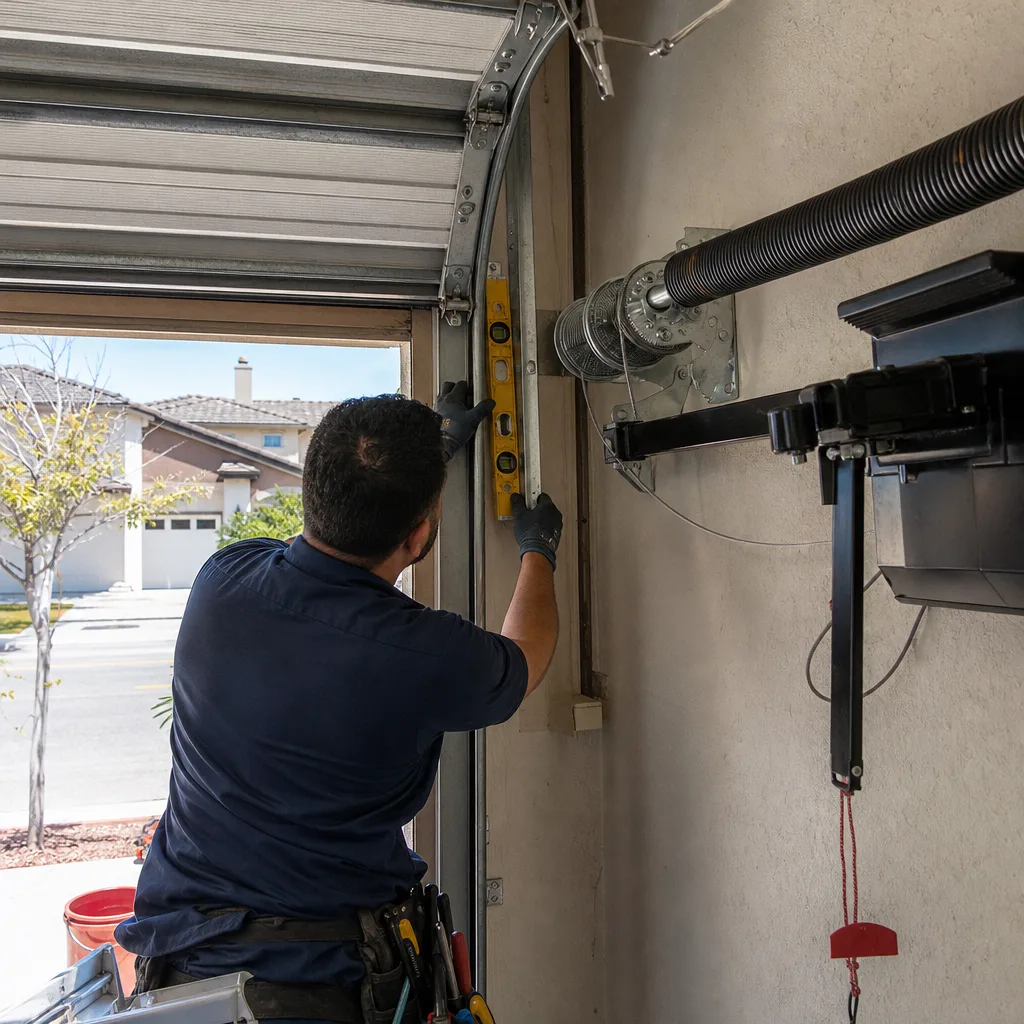
There’s a middle ground that gets overlooked in the DIY-or-don’t debate: the homeowner who does the diagnostic prep work, then hands the tension-related labor to a professional. This isn’t a compromise. It’s the economically rational move, because it reduces billable labor time without putting you on the wrong side of the spring line.
Here’s what you can do before calling for service in Irvine, step by step:
- Photograph the failed component. If the door won’t open, take pictures of the spring area, the cables, the track, and the bottom brackets from both sides. If you see a broken coil or a frayed cable, photograph it. This takes five minutes and gives the technician a diagnosis head start.
- Measure the opening. Write down door width and height, plus the distance from the header to the floor. If you know the door’s brand and approximate age, note that too. These measurements matter for spring sizing and panel matching.
- Document the symptoms. When did the problem start? Does the door open partway and stop? Does it reverse on the way down? Does the opener click without moving? Write down what the door does, not what you think is wrong with it. Specific symptoms are faster to diagnose than theories.
- Release the opener if safe to do so. If the door is in the closed position and you can reach the red emergency release cord without going under the door, pull it to disengage the opener from the door. This lets the technician know whether the problem is in the operator or the door itself. Do not do this if the door is open or partially open.
- Clear the work area. Move vehicles, trash bins, and anything else out of the garage so the technician has clear access to the tracks on both sides and the area directly under the opener motor.
None of these steps involves touching anything under tension. What they do is compress the diagnostic phase. When a technician arrives and can see the failed torsion spring in a photo you took, measure the door against specs they know, and read your symptom notes, the service call moves directly to repair. You haven’t saved the entire labor charge, but you’ve saved the diagnostic component of it, which is the portion you can honestly argue you don’t need.
This is the same principle that Servo Garage Doors Irvine home operates under: the customer sees the failed part before the quote, because Clause 4 of The Haven Standard requires the technician to photograph the failed component before quoting a replacement. The documentation you create before we arrive is raw material for the documentation we create when we get there.
How to Evaluate Whether a Professional Repair Is Priced Fairly
Fair pricing in garage door repair is measurable, not vibes-based. Our Garage Door Cost Breakdown: The Irvine Homeowner’s Reference for 2026 details the labor component of common repairs, and understanding those ranges tells you whether a quote reflects actual work or upselling.
Here’s what Irvine homeowners should expect, in real dollar terms:
| Repair Type | Typical Irvine Range | Labor Time | Parts Cost Dominant? |
|---|---|---|---|
| Torsion spring replacement (single spring) | $180-$340 | 45-75 minutes | No - labor and spring both significant |
| Torsion spring replacement (dual spring) | $280-$450 | 60-90 minutes | No - parts roughly half the total |
| Cable replacement (both sides) | $150-$250 | 30-60 minutes | No - parts under $40 |
| Opener logic board replacement | $180-$320 | 30-45 minutes | Yes - board is most of the cost |
| Roller replacement (set of 10) | $120-$200 | 30-45 minutes | No - parts under $50 |
| Full door installation (single-car, standard) | $1,200-$2,500 | 3-5 hours | Yes - door itself dominates |
These ranges reflect what we see across Irvine, from Northwood to Quail Hill. The labor time column is the useful one: it tells you whether a quote’s hourly rate is defensible. A torsion spring replacement is a 45-to-75-minute job. If a quote lands at $500 for a single spring, the implied labor rate is roughly $300 an hour, and that’s not justified by the work.
Three questions to ask any repair company in Irvine before approving a quote:
- What’s the written scope? If the answer is anything other than a specific list of parts and labor delivered before work starts, the pricing isn’t grounded. Clause 1 of The Haven Standard exists because written-scope pricing removes the invoice-surprise problem entirely.
- What does the failed part look like? A legitimate company can show you the broken spring or the burned logic board. If they can’t produce the part or a photo of it, there’s no evidence the part actually failed. This is the question that separates companies that document from companies that narrate.
- Does the price include everything? Removal of old parts, disposal, travel time, and post-repair testing should be in the number, not added as line items after the fact. Upfront pricing means the number you approve is the number you pay.
One more thing worth saying plainly: the lowest quote in Irvine is not automatically the good one. A $75 torsion spring replacement that takes 45 minutes from a company with no license, no insurance, and no written scope is not a bargain. It’s uninsured labor on a component that can injure someone if installed wrong.
What DIY Actually Costs in Total Hours
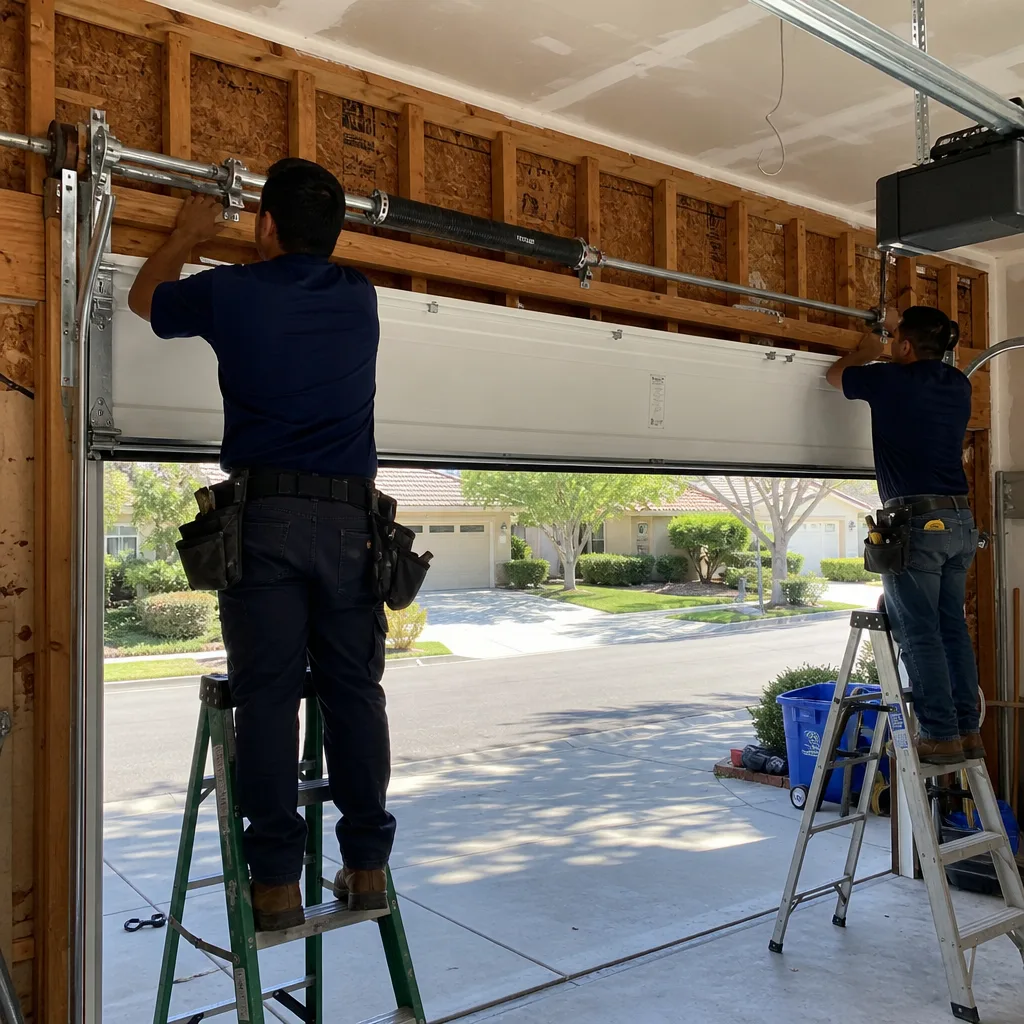
The standard defense of DIY garage door repair is the labor charge. The standard rebuttal is the total hour cost, which most homeowners never calculate.
Here’s the honest accounting for a torsion spring replacement, the most common “maybe I can do it” repair:
- Research time: Two to four hours learning how torsion springs are sized, how wind direction works, and how winding bars are used safely. YouTube tutorials alone run an hour or more, and you’ll want to watch more than one because the bar-slip moment is not covered well in short videos.
- Tool acquisition: Winding bars are specialized steel rods with a specific diameter and length. They’re not a standard wrench from your toolbox. You can buy a pair for $20 to $40, but if you buy the wrong diameter for your spring cone, the bar can slip, which is exactly the injury scenario you’re trying to avoid.
- Parts sourcing: You’ll need to identify the exact spring by wire diameter, inside diameter, length, and wind direction. That means measuring the old spring or decoding the color markings on it. Then you’ll place the order and wait one to five business days for delivery. If you got any measurement wrong, the door won’t balance correctly, and you’ll do this step twice.
- Installation time: First-time torsion spring installation runs two to four hours, including the winding process, testing, and adjustment. The winding itself is 15 to 20 minutes, but the setup, the safety checks, and the balance tuning add up.
Total realistic time: six to twelve hours across multiple days, assuming nothing goes wrong. Labor savings on the low end: $150. That’s $12 to $25 an hour for your time, before accounting for the injury risk on a component that stores enough torque to break bone.
Compare that to a weather seal replacement. Research time: 15 minutes. Tool acquisition: none beyond a utility knife. Parts sourcing: one trip to a local Irvine hardware store, under an hour. Installation: 30 minutes. Total time: under two hours. Labor savings if you’d otherwise hire it out: $80 to $120. That’s $40 to $60 an hour, no injury risk, no permit questions, no insurance implications.
The hour-cost analysis points to the same line as the safety analysis. The tasks where DIY pays well are the tasks on the safe side of the line. The tasks where DIY pays poorly are the tasks that involve stored energy. The economic signal and the safety signal point in the same direction, and that’s not a coincidence. It’s the market pricing risk.
Common Mistakes to Avoid
- Using an impact wrench to unwind a torsion spring. Impact tools work by delivering sudden torque pulses, which is the exact wrong way to interact with a spring under load. The correct tool is a set of winding bars inserted fully into the cone. A slip with an impact wrench on a wound spring is catastrophic, and unlike a winding bar slip, there’s no chance to react.
- Lubricating the spring itself with WD-40. WD-40 is a solvent, not a spring lubricant in the way homeowners assume. The spring doesn’t need lubrication; it needs to coil and uncoil without surface corrosion. If you’re lubricating anything, it’s the hinge pins and roller bearings, and the product is white lithium grease or silicone spray.
- Assuming the door needs new springs when it needs new cables. A fraying cable and a broken spring produce similar symptoms: the door stays down, or it opens unevenly. Swapping springs without inspecting cables wastes money. Swapping cables without replacing worn springs wastes labor. The two are a system, and the diagnostic step matters.
- Disengaging the opener with the door open. The red emergency release cord should only be pulled when the door is in the closed position or fully supported. Pulling it with the door open transfers the door’s entire weight to the springs and cables. If the springs are old or the cables are frayed, that’s the moment the failure happens.
- Ignoring the balance test as a wear indicator. Disengage the opener and lift the door manually to waist height. It should stay put. If it drops, the springs are weakening. If it rises, the springs are over-wound. The balance test is free, takes one minute, and tells you more about spring condition than any visual inspection.
- Buying the cheapest possible replacement part online. A $15 universal roller set from a marketplace seller is not equivalent to the nylon-ball-bearing rollers original equipment on a Clopay or Amarr door. The labor to install cheap rollers is the same as quality rollers, so the savings are paid for in shortened lifespan.
- Assuming Irvine’s climate means no maintenance. Irvine’s dry air means rust is slower than in coastal California cities, but heat and UV still degrade seals, and dry air means dry lubricant evaporates faster. A door that runs silently in June can start grinding in October because the silicone spray you applied last spring is gone.
When to Call a Professional
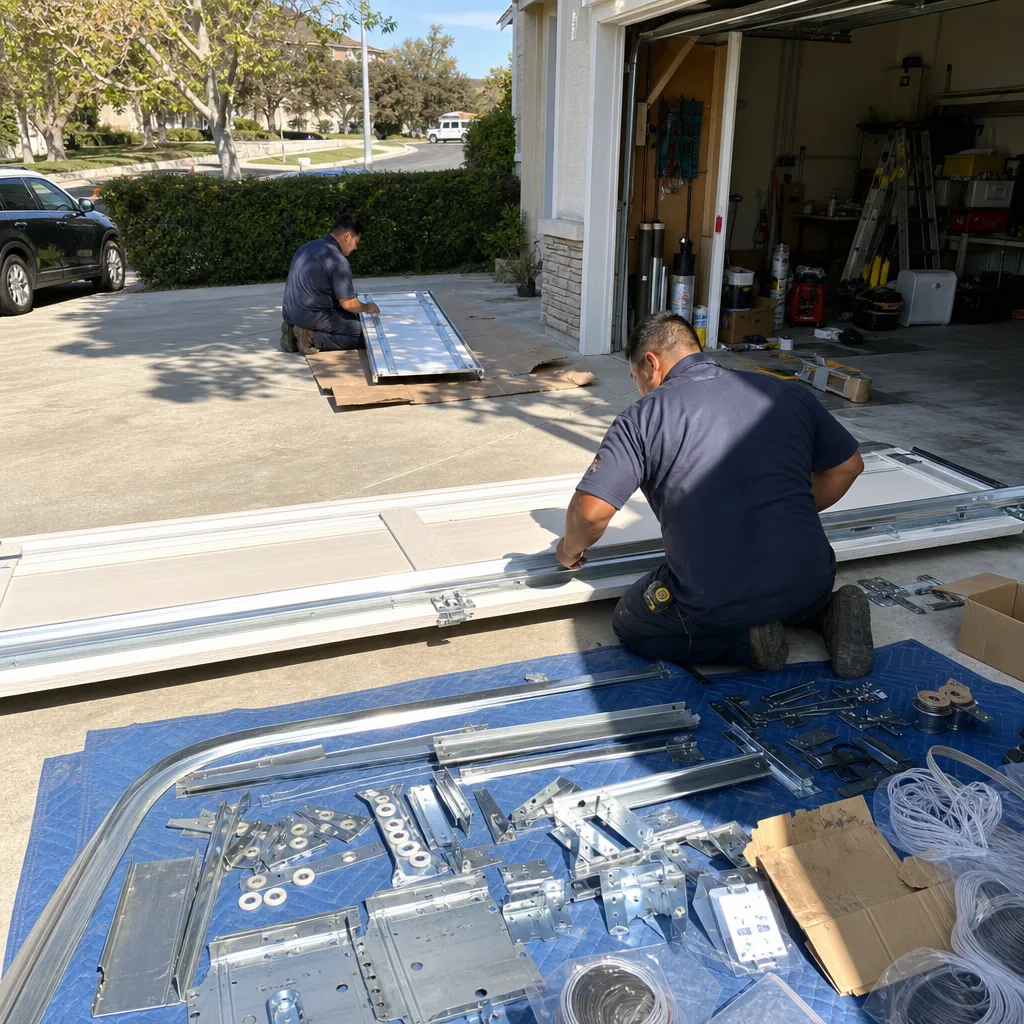
Call a professional when the problem is on the unsafe side of the line: torsion spring breakage, cable fraying or detachment, uneven door travel with tension involved, or any work that touches the structural opening. Call a professional when the door is inoperable and a vehicle is trapped, because the cost of a day without the car usually exceeds the labor charge. Call a professional when the quoted repair price seems high but the alternative involves working on spring tension, because the worst case isn’t a failed repair; it’s an injury.
Servo Garage Doors Irvine offers free estimates in Irvine - call (949) 569-5773. A flat, written price and written scope come before any work starts, and every visit closes with a photo record of what was found and what was done.
Frequently Asked Questions
Yes, it’s legal under California law for a homeowner to work on their own property without a contractor’s license, and non-structural garage door work like spring replacement doesn’t require a permit in Irvine. Legal doesn’t mean advisable. The liability lands entirely on the homeowner if the repair fails or injures someone, and that liability typically exceeds the labor savings.
A single torsion spring replacement in Irvine typically runs $180 to $340, and a dual spring runs $280 to $450, including parts and labor. The spread reflects spring size and door weight. A written quote before work starts should specify the spring dimensions and the labor line. Call (949) 569-5773 for an exact number on your door.
If you match the wire diameter, inside diameter, length, and wind direction exactly, a same-size replacement will work, but the door’s balance depends on the spring matching the door’s weight as well as its dimensions. A door with replaced panels, an added strut, or a heavier opener may need a different spring cycle than the original. Professional spring sizing accounts for the door’s current configuration, not just the spring that was there before.
The most common mistake we see in Irvine is homeowners lubricating the torsion spring itself instead of the hinges and roller bearings. The spring doesn’t need lubrication to do its job, and spraying it can attract grit that accelerates coil wear. Less common but far more serious is attempting spring work with improvised tools, which turns a repairable door into an injury.
Torsion springs are rated in cycles, not years, and most residential springs are rated for 10,000 cycles, which translates to roughly 7 to 10 years for an Irvine home where the door opens three to four times a day. Coastal humidity shortens spring life more than Irvine’s dry heat does, but the cycle rating is the real determinant. If your door is approaching a decade on original springs, budget for replacement.
No. A flat, written price and written scope should be delivered before any work starts, and that’s exactly how Clause 1 of The Haven Standard works at Servo Garage Doors Irvine. The technician photographs the failed component, writes the scope, gets your approval, and then works. The price you approve is the price you pay. If a company can’t do that, get a second quote. Our Free Second Opinion applies to any written estimate from another company.
The Bottom Line
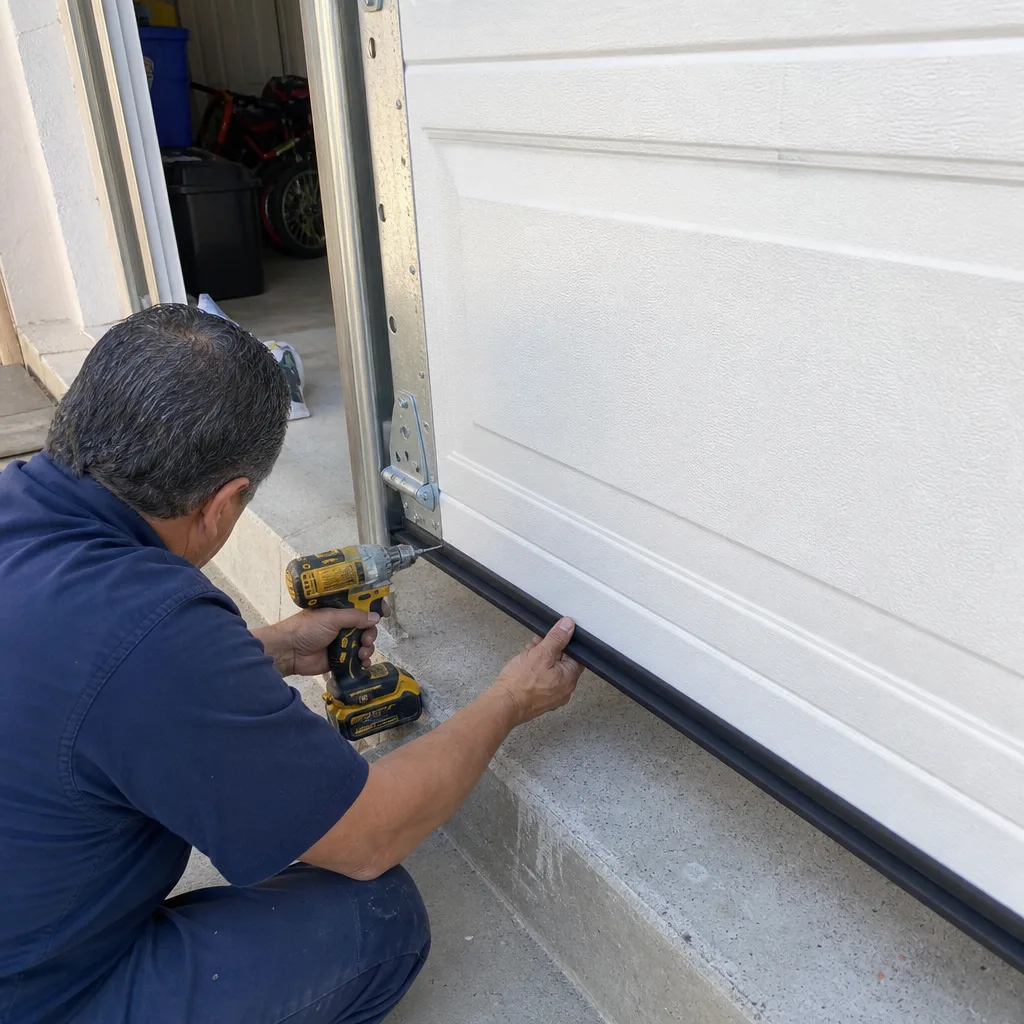
The DIY-versus-professional decision for garage doors in Irvine is not a referendum on your competence. It’s a risk-return calculation where the risk variable is stored mechanical energy, not skill level. Lubricate, replace seals, swap remote batteries, and adjust limit switches yourself; those tasks pay well and injure nobody. Leave torsion springs, cables, and header work to someone who carries the right tools and the right insurance. Document what you find before you call, ask for written pricing, and remember that the company that shows you the broken part is the company that’s actually doing the work. For additional guidance, explore more guides & resources from our team.
Written by Marcus Deller, Owner at Servo Garage Doors Irvine, serving Irvine since 2015.